|
DMP_BBO library
|
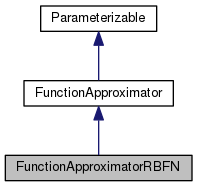
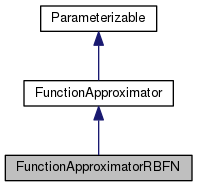
RBFN (Radial Basis Function Network) function approximator. More...
#include <FunctionApproximatorRBFN.hpp>
Public Member Functions | |
| FunctionApproximatorRBFN (const MetaParametersRBFN *const meta_parameters, const ModelParametersRBFN *const model_parameters=NULL) | |
| Initialize a function approximator with meta- and model-parameters. More... | |
| FunctionApproximatorRBFN (const ModelParametersRBFN *const model_parameters) | |
| Initialize a function approximator with model parameters. More... | |
| FunctionApproximator * | clone (void) const |
| Return a pointer to a deep copy of the FunctionApproximator object. More... | |
| void | train (const Eigen::Ref< const Eigen::MatrixXd > &inputs, const Eigen::Ref< const Eigen::MatrixXd > &targets) |
| Train the function approximator with corresponding input and target examples. More... | |
| void | predict (const Eigen::Ref< const Eigen::MatrixXd > &inputs, Eigen::MatrixXd &output) |
| Query the function approximator to make a prediction. More... | |
| void | preallocateMemory (int n_basis_functions) |
| Preallocate memory to make certain functions real-time. More... | |
| std::string | getName (void) const |
| Get the name of this function approximator. More... | |
| bool | saveGridData (const Eigen::VectorXd &min, const Eigen::VectorXd &max, const Eigen::VectorXi &n_samples_per_dim, std::string directory, bool overwrite=false) const |
| Generate a grid of inputs, and output the response of the basis functions and line segments for these inputs. More... | |
 Public Member Functions inherited from FunctionApproximator Public Member Functions inherited from FunctionApproximator | |
| FunctionApproximator (const MetaParameters *const meta_parameters, const ModelParameters *const model_parameters=NULL) | |
| Initialize a function approximator with meta- and optionally model-parameters. More... | |
| FunctionApproximator (const ModelParameters *const model_parameters) | |
| Initialize a function approximator with model-parameters. More... | |
| void | train (const Eigen::Ref< const Eigen::MatrixXd > &inputs, const Eigen::Ref< const Eigen::MatrixXd > &targets, std::string save_directory, bool overwrite=false) |
| Train the function approximator with corresponding input and target examples (and write results to file). More... | |
| void | reTrain (const Eigen::Ref< const Eigen::MatrixXd > &inputs, const Eigen::Ref< const Eigen::MatrixXd > &targets) |
| Re-train the function approximator with corresponding input and target examples. More... | |
| void | reTrain (const Eigen::Ref< const Eigen::MatrixXd > &inputs, const Eigen::Ref< const Eigen::MatrixXd > &targets, std::string save_directory, bool overwrite=false) |
| Re-train the function approximator with corresponding input and target examples (and write results to file). More... | |
| virtual void | predict (const Eigen::Ref< const Eigen::MatrixXd > &inputs, Eigen::MatrixXd &outputs, Eigen::MatrixXd &variances) |
| Query the function approximator to make a prediction, and also to predict its variance. More... | |
| virtual void | predict (const Eigen::Ref< const Eigen::MatrixXd > &inputs, Eigen::MatrixXd &outputs, std::vector< Eigen::MatrixXd > &variances) |
| Query the function approximator to make a prediction, and also to predict its variance. More... | |
| virtual void | predictVariance (const Eigen::Ref< const Eigen::MatrixXd > &inputs, Eigen::MatrixXd &variances) |
| Query the function approximator to get the variance of a prediction This function is not implemented by all function approximators. More... | |
| bool | isTrained (void) const |
| Determine whether the function approximator has already been trained with data or not. More... | |
| int | getExpectedInputDim (void) const |
| The expected dimensionality of the input data. More... | |
| int | getExpectedOutputDim (void) const |
| The expected dimensionality of the output data. More... | |
| void | getSelectableParameters (std::set< std::string > &selected_values_labels) const |
| Return all the names of the parameter types that can be selected. More... | |
| void | setSelectedParameters (const std::set< std::string > &selected_values_labels) |
| Determine which subset of parameters is represented in the vector returned by Parameterizable::getParameterVectorSelected. More... | |
| void | getParameterVectorSelectedMinMax (Eigen::VectorXd &min, Eigen::VectorXd &max) const |
| Get the minimum and maximum of the selected parameters in one vector. More... | |
| int | getParameterVectorSelectedSize (void) const |
| Get the size of the vector of selected parameters, as returned by getParameterVectorSelected(. More... | |
| void | setParameterVectorSelected (const Eigen::VectorXd &values, bool normalized=false) |
| Set all the values of the selected parameters with one vector. More... | |
| void | getParameterVectorSelected (Eigen::VectorXd &values, bool normalized=false) const |
| Get the values of the selected parameters in one vector. More... | |
| void | getParameterVectorMask (const std::set< std::string > selected_values_labels, Eigen::VectorXi &selected_mask) const |
| Get a mask for selecting parameters. More... | |
| int | getParameterVectorAllSize (void) const |
| Get the size of the parameter values vector when it contains all available parameter values. More... | |
| void | getParameterVectorAll (Eigen::VectorXd &values) const |
| Return a vector that returns all available parameter values. More... | |
| void | setParameterVectorAll (const Eigen::VectorXd &values) |
| Set all available parameter values with one vector. More... | |
| UnifiedModel * | getUnifiedModel (void) const |
| Return a representation of this function approximator's model as a unified model. More... | |
| std::string | toString (void) const |
| Returns a string representation of the object. More... | |
| const MetaParameters * | getMetaParameters (void) const |
| Accessor for FunctionApproximator::meta_parameters_. More... | |
| const ModelParameters * | getModelParameters (void) const |
| Accessor for FunctionApproximator::model_parameters_. More... | |
| void | setParameterVectorModifierPrivate (std::string modifier, bool new_value) |
| Turn certain modifiers on or off, see Parameterizable::setParameterVectorModifier(). More... | |
| Public Member Functions inherited from Parameterizable | |
| virtual | ~Parameterizable (void) |
| Destructor. | |
| virtual void | getParameterVectorSelectedNormalized (Eigen::VectorXd &values) const |
| Get the normalized values of the selected parameters in one vector. More... | |
| void | getParameterVectorSelectedMinMax (Eigen::VectorXd &min, Eigen::VectorXd &max) const |
| Get the minimum and maximum of the selected parameters in one vector. More... | |
| void | getParameterVectorAllMinMax (Eigen::VectorXd &min, Eigen::VectorXd &max) const |
| Get the minimum and maximum values of the current parameter vector. More... | |
| void | getParameterVectorSelectedRanges (Eigen::VectorXd &ranges) const |
| Get the ranges of the selected parameters, i.e. More... | |
| virtual void | setParameterVectorSelectedNormalized (const Eigen::VectorXd &values) |
| Set all the values of the selected parameters with one vector of normalized values. More... | |
| void | setSelectedParametersOne (std::string selected) |
| Set the parameters that are currently selected. More... | |
| void | setParameterVectorModifier (std::string modifier, bool new_value) |
| Turn certain modifiers on or off. More... | |
| void | setVectorLengthsPerDimension (const Eigen::VectorXi &lengths_per_dimension) |
| The vector (VectorXd) with parameter values can be split into different parts (as vector<VectorXd>; this function specifices the length of each sub-vector. More... | |
| Eigen::VectorXi | getVectorLengthsPerDimension (void) const |
| Get the specified length of each vector in each dimension. More... | |
| void | getParameterVectorSelected (std::vector< Eigen::VectorXd > &values, bool normalized=false) const |
| Get the values of the selected parameters in one vector. More... | |
| void | setParameterVectorSelected (const std::vector< Eigen::VectorXd > &values, bool normalized=false) |
| Set all the values of the selected parameters with a vector of vectors. More... | |
Friends | |
| class | boost::serialization::access |
| Give boost serialization access to private members. More... | |
Additional Inherited Members | |
| Static Public Member Functions inherited from FunctionApproximator | |
| static void | generateInputsGrid (const Eigen::VectorXd &min, const Eigen::VectorXd &max, const Eigen::VectorXi &n_samples_per_dim, Eigen::MatrixXd &inputs_grid) |
| Generate a input samples that lie on a grid (much like Matlab's meshgrid) For instance, if min = [2 6], and max = [3 8], and n_samples_per_dim = [3 5] then this function first makes linearly spaces samples along each dimension, e.g. More... | |
| Protected Member Functions inherited from FunctionApproximator | |
| void | setModelParameters (ModelParameters *model_parameters) |
| Accessor for FunctionApproximator::model_parameters_. More... | |
| FunctionApproximator (void) | |
| Default constructor. More... | |
RBFN (Radial Basis Function Network) function approximator.
Definition at line 43 of file FunctionApproximatorRBFN.hpp.
| FunctionApproximatorRBFN | ( | const MetaParametersRBFN *const | meta_parameters, |
| const ModelParametersRBFN *const | model_parameters = NULL |
||
| ) |
Initialize a function approximator with meta- and model-parameters.
| [in] | meta_parameters | The training algorithm meta-parameters |
| [in] | model_parameters | The parameters of the trained model. If this parameter is not passed, the function approximator is initialized as untrained. In this case, you must call FunctionApproximator::train() before being able to call FunctionApproximator::predict(). Either meta_parameters XOR model-parameters can passed as NULL, but not both. |
Definition at line 51 of file FunctionApproximatorRBFN.cpp.
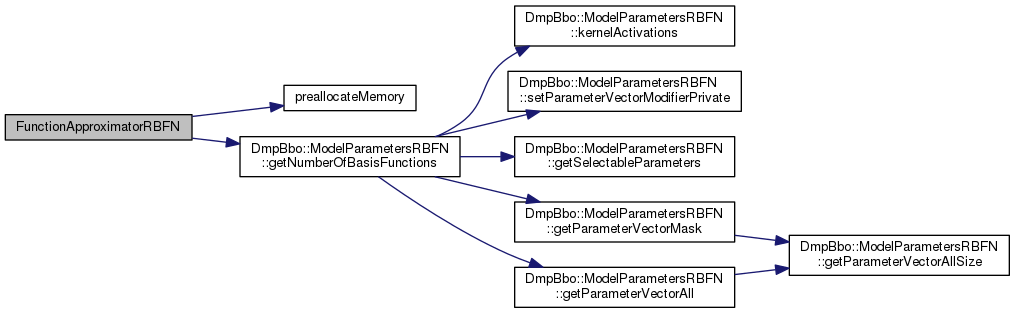
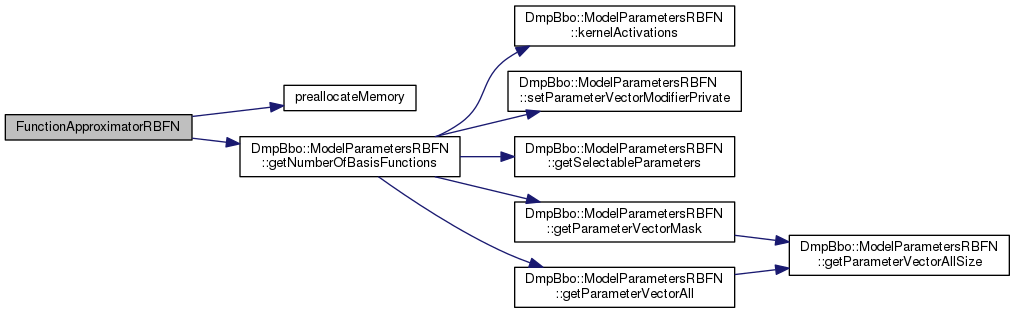
| FunctionApproximatorRBFN | ( | const ModelParametersRBFN *const | model_parameters | ) |
Initialize a function approximator with model parameters.
| [in] | model_parameters | The parameters of the (previously) trained model. |
Definition at line 59 of file FunctionApproximatorRBFN.cpp.
|
virtual |
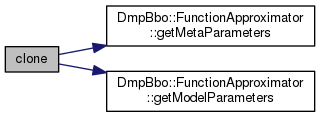
Return a pointer to a deep copy of the FunctionApproximator object.
Implements FunctionApproximator.
Definition at line 74 of file FunctionApproximatorRBFN.cpp.
|
virtual |
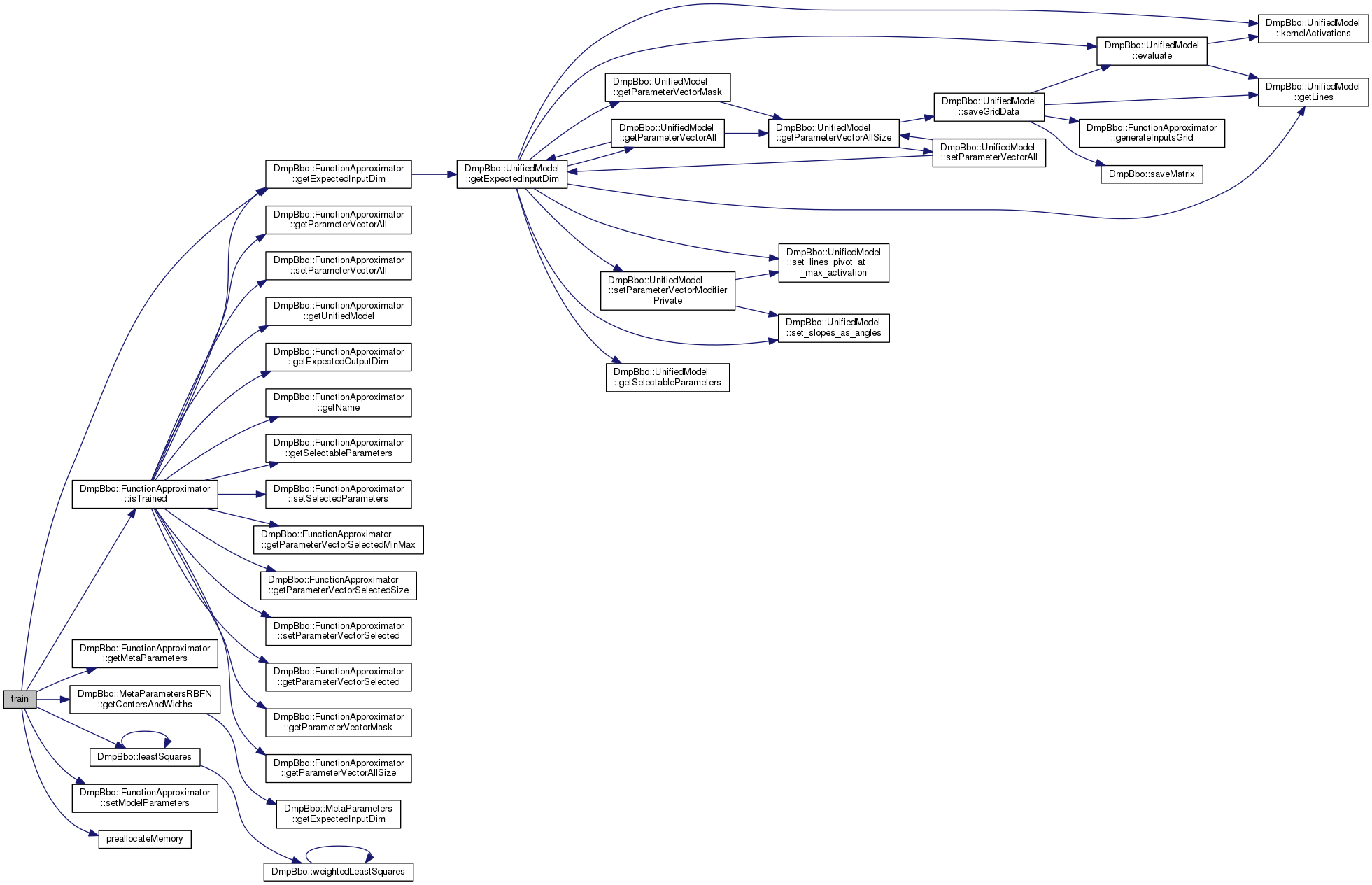
Train the function approximator with corresponding input and target examples.
| [in] | inputs | Input values of the training examples |
| [in] | targets | Target values of the training examples |
Implements FunctionApproximator.
Definition at line 82 of file FunctionApproximatorRBFN.cpp.
|
virtual |
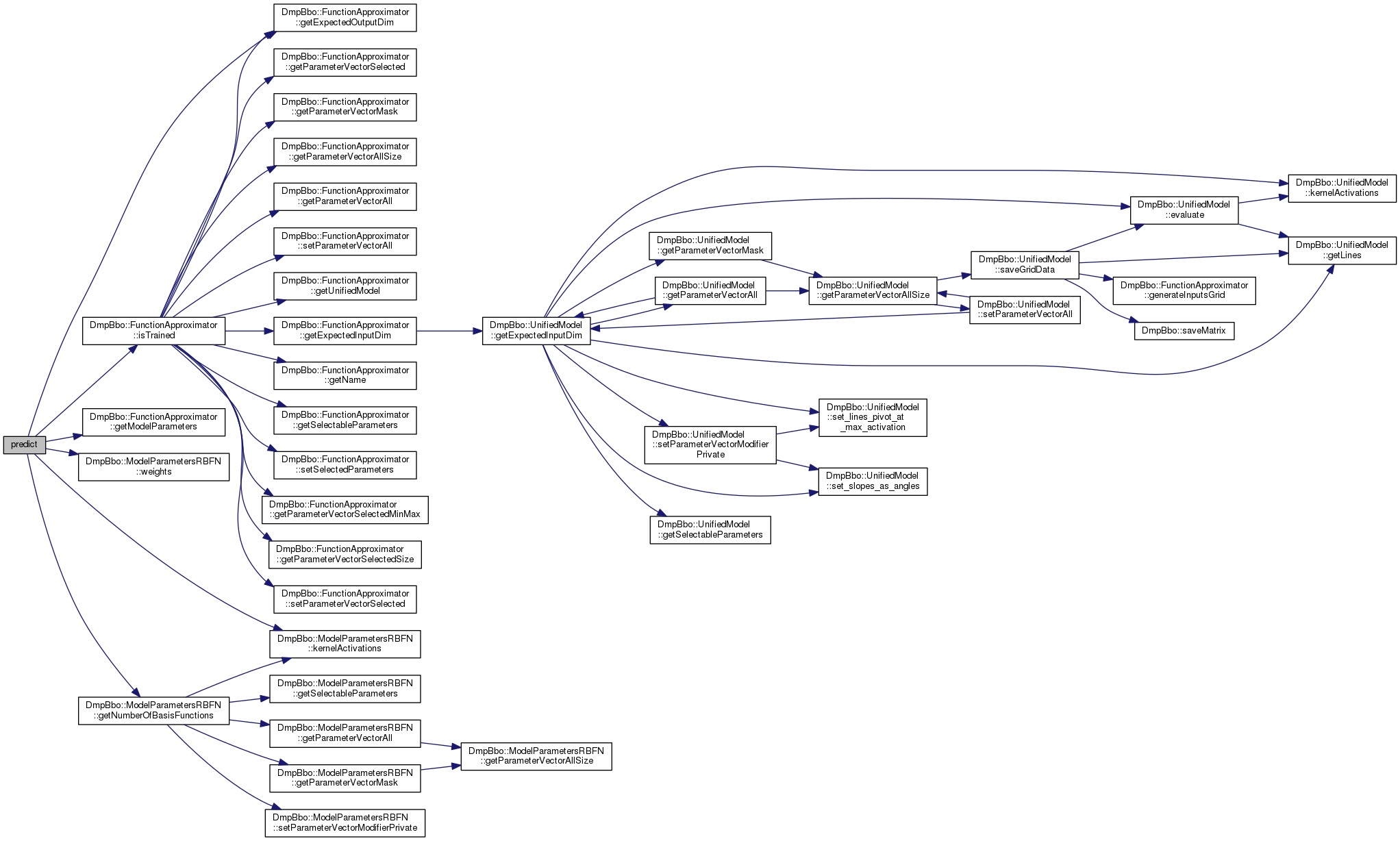
Query the function approximator to make a prediction.
| [in] | inputs | Input values of the query |
| [out] | outputs | Predicted output values |
Implements FunctionApproximator.
Definition at line 123 of file FunctionApproximatorRBFN.cpp.
| void preallocateMemory | ( | int | n_basis_functions | ) |
Preallocate memory to make certain functions real-time.
| [in] | n_basis_functions | Number of basis functions in the RBFN. |
Definition at line 66 of file FunctionApproximatorRBFN.cpp.
|
inlinevirtual |
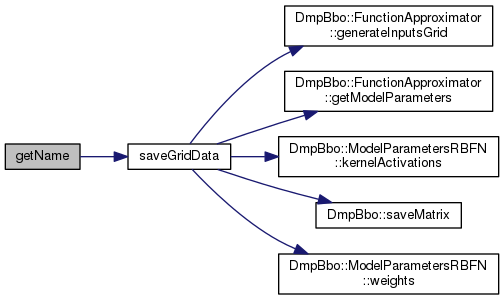
Get the name of this function approximator.
Implements FunctionApproximator.
Definition at line 73 of file FunctionApproximatorRBFN.hpp.
|
virtual |
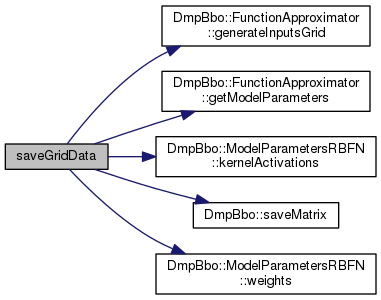
Generate a grid of inputs, and output the response of the basis functions and line segments for these inputs.
This function is not pure virtual, because this might not make sense for every model parameters class.
| [in] | min | Minimum values for the grid (one for each dimension) |
| [in] | max | Maximum values for the grid (one for each dimension) |
| [in] | n_samples_per_dim | Number of samples in the grid along each dimension |
| [in] | directory | Directory to which to save the results to. |
| [in] | overwrite | Whether to overwrite existing files. true=do overwrite, false=don't overwrite and give a warning. |
Reimplemented from FunctionApproximator.
Definition at line 176 of file FunctionApproximatorRBFN.cpp.
|
friend |
Give boost serialization access to private members.
Definition at line 98 of file FunctionApproximatorRBFN.hpp.
 1.8.11

