DMP_BBO library
Public Types | Public Member Functions | Protected Member Functions | Friends | List of all members

Implementation of Dynamical Movement Primitives. More...

#include <Dmp.hpp>

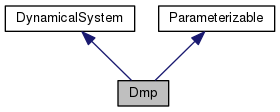
Inheritance diagram for Dmp:
Inheritance graph
[legend]
Collaboration diagram for Dmp:
Collaboration graph
[legend]

Public Types

enum  DmpType { IJSPEERT_2002_MOVEMENT, KULVICIUS_2012_JOINING, COUNTDOWN_2013 }
 Different types of DMPs that can be initialized. More...
 
enum  ForcingTermScaling { NO_SCALING, G_MINUS_Y0_SCALING, AMPLITUDE_SCALING }
 Different ways to scale the forcing term. More...
 
- Public Types inherited from DynamicalSystem
enum  IntegrationMethod { EULER, RUNGE_KUTTA }
 The possible integration methods that can be used. More...
 

Public Member Functions

 Dmp (double tau, Eigen::VectorXd y_init, Eigen::VectorXd y_attr, std::vector< FunctionApproximator * > function_approximators, double alpha_spring_damper, DynamicalSystem *goal_system, DynamicalSystem *phase_system, DynamicalSystem *gating_system, ForcingTermScaling scaling=NO_SCALING)
 Initialization constructor. More...
 
 Dmp (int n_dims_dmp, std::vector< FunctionApproximator * > function_approximators, double alpha_spring_damper, DynamicalSystem *goal_system, DynamicalSystem *phase_system, DynamicalSystem *gating_system, ForcingTermScaling scaling=NO_SCALING)
 Initialization constructor for Dmps of known dimensionality, but with unknown initial and attractor states. More...
 
 Dmp (double tau, Eigen::VectorXd y_init, Eigen::VectorXd y_attr, std::vector< FunctionApproximator * > function_approximators, DmpType dmp_type=KULVICIUS_2012_JOINING, ForcingTermScaling scaling=NO_SCALING)
 Constructor that initializes the DMP with default dynamical systems. More...
 
 Dmp (int n_dims_dmp, std::vector< FunctionApproximator * > function_approximators, DmpType dmp_type=KULVICIUS_2012_JOINING, ForcingTermScaling scaling=NO_SCALING)
 Initialization constructor for Dmps of known dimensionality, but with unknown initial and attractor states. More...
 
 Dmp (double tau, Eigen::VectorXd y_init, Eigen::VectorXd y_attr, double alpha_spring_damper, DynamicalSystem *goal_system)
 Initialization constructor for Dmps without a forcing term. More...
 
 ~Dmp (void)
 Destructor. More...
 
Dmpclone (void) const
 Return a deep copy of this object. More...
 
virtual void integrateStart (Eigen::Ref< Eigen::VectorXd > x, Eigen::Ref< Eigen::VectorXd > xd) const
 Start integrating the system. More...
 
void differentialEquation (const Eigen::Ref< const Eigen::VectorXd > &x, Eigen::Ref< Eigen::VectorXd > xd) const
 The differential equation which defines the system. More...
 
void analyticalSolution (const Eigen::VectorXd &ts, Eigen::MatrixXd &xs, Eigen::MatrixXd &xds, Eigen::MatrixXd &forcing_terms, Eigen::MatrixXd &fa_output) const
 Return analytical solution of the system at certain times (and return forcing terms) More...
 
void analyticalSolution (const Eigen::VectorXd &ts, Eigen::MatrixXd &xs, Eigen::MatrixXd &xds, Eigen::MatrixXd &forcing_terms) const
 Return analytical solution of the system at certain times (and return forcing terms) More...
 
void analyticalSolution (const Eigen::VectorXd &ts, Eigen::MatrixXd &xs, Eigen::MatrixXd &xds) const
 Return analytical solution of the system at certain times. More...
 
virtual void analyticalSolution (const Eigen::VectorXd &ts, Trajectory &trajectory) const
 Return analytical solution of the system at certain times. More...
 
void analyticalSolution (const Eigen::VectorXd &ts, Trajectory &trajectory, Eigen::MatrixXd &forcing_terms) const
 Return analytical solution of the system at certain times. More...
 
virtual void statesAsTrajectory (const Eigen::MatrixXd &x_in, const Eigen::MatrixXd &xd_in, Eigen::MatrixXd &y_out, Eigen::MatrixXd &yd_out, Eigen::MatrixXd &ydd_out) const
 Get the output of a DMP dynamical system as a trajectory. More...
 
virtual void statesAsTrajectory (const Eigen::VectorXd &ts, const Eigen::MatrixXd &x_in, const Eigen::MatrixXd &xd_in, Trajectory &trajectory) const
 Get the output of a DMP dynamical system as a trajectory. More...
 
virtual void train (const Trajectory &trajectory)
 Train a DMP with a trajectory. More...
 
virtual void train (const Trajectory &trajectory, std::string save_directory, bool overwrite=false)
 Train a DMP with a trajectory, and write results to file. More...
 
virtual void set_tau (double tau)
 Accessor function for the time constant. More...
 
virtual void set_initial_state (const Eigen::VectorXd &y_init)
 Accessor function for the initial state of the system. More...
 
virtual void set_attractor_state (const Eigen::VectorXd &y_attr)
 Accessor function for the attractor state of the system. More...
 
void set_damping_coefficient (double damping_coefficient)
 Accessor function for damping coefficient of spring-damper system. More...
 
void set_spring_constant (double spring_constant)
 Accessor function for spring constant of spring-damper system. More...
 
std::string toString (void) const
 Returns a string representation of the object. More...
 
void getSelectableParameters (std::set< std::string > &selectable_values_labels) const
 Return all the names of the parameter types that can be selected. More...
 
void setSelectedParameters (const std::set< std::string > &selected_values_labels)
 Determine which subset of parameters is represented in the vector returned by Parameterizable::getParameterVectorSelected. More...
 
int getParameterVectorAllSize (void) const
 Get the size of the parameter values vector when it contains all available parameter values. More...
 
void getParameterVectorAll (Eigen::VectorXd &values) const
 Return a vector that returns all available parameter values. More...
 
void setParameterVectorAll (const Eigen::VectorXd &values)
 Set all available parameter values with one vector. More...
 
void getParameterVectorMask (const std::set< std::string > selected_values_labels, Eigen::VectorXi &selected_mask) const
 Get a mask for selecting parameters. More...
 
void computeFunctionApproximatorInputsAndTargets (const Trajectory &trajectory, Eigen::VectorXd &fa_inputs_phase, Eigen::MatrixXd &fa_targets) const
 Given a trajectory, compute the inputs and targets for the function approximators. More...
 
virtual void computeFunctionApproximatorOutput (const Eigen::Ref< const Eigen::MatrixXd > &phase_state, Eigen::MatrixXd &fa_output) const
 Compute the outputs of the function approximators. More...
 
void set_perturbation_analytical_solution (double perturbation_standard_deviation)
 Add a perturbation to the forcing term when computing the analytical solution. More...
 
double get_perturbation_analytical_solution () const
 Get the perturbation to the forcing term when computing the analytical solution. More...
 
- Public Member Functions inherited from DynamicalSystem
 DynamicalSystem (int order, double tau, Eigen::VectorXd initial_state, Eigen::VectorXd attractor_state, std::string name)
 Initialization constructor. More...
 
virtual ~DynamicalSystem (void)
 Destructor.
 
void integrateStart (const Eigen::VectorXd &x_init, Eigen::Ref< Eigen::VectorXd > x, Eigen::Ref< Eigen::VectorXd > xd)
 Start integrating the system with a new initial state. More...
 
virtual void integrateStep (double dt, const Eigen::Ref< const Eigen::VectorXd > x, Eigen::Ref< Eigen::VectorXd > x_updated, Eigen::Ref< Eigen::VectorXd > xd_updated) const
 Integrate the system one time step. More...
 
void set_integration_method (IntegrationMethod integration_method)
 Choose the integration method. More...
 
int dim (void) const
 Get the dimensionality of the dynamical system, i.e. More...
 
int dim_orig (void) const
 Get the dimensionality of the dynamical system, i.e. More...
 
double tau (void) const
 Accessor function for the time constant. More...
 
Eigen::VectorXd initial_state (void) const
 Accessor function for the initial state of the dynamical system. More...
 
void initial_state (Eigen::VectorXd &initial_state) const
 Accessor function for the initial state of the dynamical system. More...
 
Eigen::VectorXd attractor_state (void) const
 Accessor function for the attractor state of the dynamical system. More...
 
void attractor_state (Eigen::VectorXd &attractor_state) const
 Accessor function for the attractor state of the dynamical system. More...
 
virtual void set_attractor_state (const Eigen::Ref< const Eigen::VectorXd > &attractor_state)
 Mutator function for the attractor state of the dynamical system. More...
 
std::string name (void) const
 Accessor function for the name of the dynamical system. More...
 
virtual void set_name (std::string name)
 Mutator function for the name of the dynamical system. More...
 
- Public Member Functions inherited from Parameterizable
virtual ~Parameterizable (void)
 Destructor.
 
virtual int getParameterVectorSelectedSize (void) const
 Get the size of the vector of selected parameters, as returned by getParameterVectorSelected(. More...
 
virtual void getParameterVectorSelected (Eigen::VectorXd &values, bool normalized=false) const
 Get the values of the selected parameters in one vector. More...
 
virtual void getParameterVectorSelectedNormalized (Eigen::VectorXd &values) const
 Get the normalized values of the selected parameters in one vector. More...
 
void getParameterVectorSelectedMinMax (Eigen::VectorXd &min, Eigen::VectorXd &max) const
 Get the minimum and maximum of the selected parameters in one vector. More...
 
void getParameterVectorAllMinMax (Eigen::VectorXd &min, Eigen::VectorXd &max) const
 Get the minimum and maximum values of the current parameter vector. More...
 
void getParameterVectorSelectedRanges (Eigen::VectorXd &ranges) const
 Get the ranges of the selected parameters, i.e. More...
 
virtual void setParameterVectorSelected (const Eigen::VectorXd &values, bool normalized=false)
 Set all the values of the selected parameters with one vector. More...
 
virtual void setParameterVectorSelectedNormalized (const Eigen::VectorXd &values)
 Set all the values of the selected parameters with one vector of normalized values. More...
 
void setSelectedParametersOne (std::string selected)
 Set the parameters that are currently selected. More...
 
void setParameterVectorModifier (std::string modifier, bool new_value)
 Turn certain modifiers on or off. More...
 
void setVectorLengthsPerDimension (const Eigen::VectorXi &lengths_per_dimension)
 The vector (VectorXd) with parameter values can be split into different parts (as vector<VectorXd>; this function specifices the length of each sub-vector. More...
 
Eigen::VectorXi getVectorLengthsPerDimension (void) const
 Get the specified length of each vector in each dimension. More...
 
void getParameterVectorSelected (std::vector< Eigen::VectorXd > &values, bool normalized=false) const
 Get the values of the selected parameters in one vector. More...
 
void setParameterVectorSelected (const std::vector< Eigen::VectorXd > &values, bool normalized=false)
 Set all the values of the selected parameters with a vector of vectors. More...
 

Protected Member Functions

FunctionApproximatorfunction_approximator (int i_dim) const
 Get a pointer to the function approximator for a certain dimension. More...
 
- Protected Member Functions inherited from DynamicalSystem
 DynamicalSystem (void)
 Default constructor. More...
 
void set_dim (int dim)
 Set the dimensionality of the dynamical system, i.e. More...
 

Friends

class boost::serialization::access
 Give boost serialization access to private members. More...
 

Detailed Description

Implementation of Dynamical Movement Primitives.

Definition at line 56 of file Dmp.hpp.

Member Enumeration Documentation

enum DmpType

Different types of DMPs that can be initialized.

Definition at line 61 of file Dmp.hpp.

61 { IJSPEERT_2002_MOVEMENT, KULVICIUS_2012_JOINING, COUNTDOWN_2013 };

Different ways to scale the forcing term.

Definition at line 64 of file Dmp.hpp.

64 { NO_SCALING, G_MINUS_Y0_SCALING, AMPLITUDE_SCALING };

Constructor & Destructor Documentation

Dmp ( double  tau,
Eigen::VectorXd  y_init,
Eigen::VectorXd  y_attr,
std::vector< FunctionApproximator * >  function_approximators,
double  alpha_spring_damper,
DynamicalSystem goal_system,
DynamicalSystem phase_system,
DynamicalSystem gating_system,
ForcingTermScaling  scaling = NO_SCALING 
)

Initialization constructor.

Parameters
tauTime constant
y_initInitial state
y_attrAttractor state
alpha_spring_damper$\alpha$ in the spring-damper system of the dmp
goal_systemDynamical system to compute delayed goal
phase_systemDynamical system to compute the phase
gating_systemDynamical system to compute the gating term
function_approximatorsFunction approximators for the forcing term
scalingWhich method to use for scaling the forcing term (see Dmp::ForcingTermScaling)

Definition at line 85 of file Dmp.cpp.

92  : DynamicalSystem(1, tau, y_init, y_attr, "name"),
93  goal_system_(goal_system),
94  phase_system_(phase_system), gating_system_(gating_system),
95  forcing_term_scaling_(scaling)
96 {
97  initSubSystems(alpha_spring_damper, goal_system, phase_system, gating_system);
98  initFunctionApproximators(function_approximators);
99 }
double tau(void) const
Accessor function for the time constant.
DynamicalSystem(void)
Default constructor.
Dmp ( int  n_dims_dmp,
std::vector< FunctionApproximator * >  function_approximators,
double  alpha_spring_damper,
DynamicalSystem goal_system,
DynamicalSystem phase_system,
DynamicalSystem gating_system,
ForcingTermScaling  scaling = NO_SCALING 
)

Initialization constructor for Dmps of known dimensionality, but with unknown initial and attractor states.

Parameters
n_dims_dmpDimensionality of the DMP
alpha_spring_damper$\alpha$ in the spring-damper system of the dmp
goal_systemDynamical system to compute delayed goal
phase_systemDynamical system to compute the phase
gating_systemDynamical system to compute the gating term
function_approximatorsFunction approximators for the forcing term
scalingWhich method to use for scaling the forcing term (see Dmp::ForcingTermScaling)

Definition at line 102 of file Dmp.cpp.

106  : DynamicalSystem(1, 1.0, VectorXd::Zero(n_dims_dmp), VectorXd::Ones(n_dims_dmp), "name"),
107  goal_system_(goal_system),
108  phase_system_(phase_system), gating_system_(gating_system),
109  forcing_term_scaling_(scaling)
110 {
111  initSubSystems(alpha_spring_damper, goal_system, phase_system, gating_system);
112  initFunctionApproximators(function_approximators);
113 }
DynamicalSystem(void)
Default constructor.
Dmp ( double  tau,
Eigen::VectorXd  y_init,
Eigen::VectorXd  y_attr,
std::vector< FunctionApproximator * >  function_approximators,
DmpType  dmp_type = KULVICIUS_2012_JOINING,
ForcingTermScaling  scaling = NO_SCALING 
)

Constructor that initializes the DMP with default dynamical systems.

Parameters
tauTime constant
y_initInitial state
y_attrAttractor state
function_approximatorsFunction approximators for the forcing term
dmp_typeThe type of DMP, see Dmp::DmpType
scalingWhich method to use for scaling the forcing term (see Dmp::ForcingTermScaling)

Definition at line 115 of file Dmp.cpp.

119  : DynamicalSystem(1, tau, y_init, y_attr, "name"),
120  forcing_term_scaling_(scaling)
121 {
122  initSubSystems(dmp_type);
123  initFunctionApproximators(function_approximators);
124 }
double tau(void) const
Accessor function for the time constant.
DynamicalSystem(void)
Default constructor.
Dmp ( int  n_dims_dmp,
std::vector< FunctionApproximator * >  function_approximators,
DmpType  dmp_type = KULVICIUS_2012_JOINING,
ForcingTermScaling  scaling = NO_SCALING 
)

Initialization constructor for Dmps of known dimensionality, but with unknown initial and attractor states.

Initializes the DMP with default dynamical systems.

Parameters
n_dims_dmpDimensionality of the DMP
function_approximatorsFunction approximators for the forcing term
dmp_typeThe type of DMP, see Dmp::DmpType
scalingWhich method to use for scaling the forcing term (see Dmp::ForcingTermScaling)

Definition at line 126 of file Dmp.cpp.

129  : DynamicalSystem(1, 1.0, VectorXd::Zero(n_dims_dmp), VectorXd::Ones(n_dims_dmp), "name"),
130  forcing_term_scaling_(scaling)
131 {
132  initSubSystems(dmp_type);
133  initFunctionApproximators(function_approximators);
134 }
DynamicalSystem(void)
Default constructor.
Dmp ( double  tau,
Eigen::VectorXd  y_init,
Eigen::VectorXd  y_attr,
double  alpha_spring_damper,
DynamicalSystem goal_system 
)

Initialization constructor for Dmps without a forcing term.

Parameters
tauTime constant
y_initInitial state
y_attrAttractor state
alpha_spring_damper$\alpha$ in the spring-damper system of the dmp
goal_systemDynamical system to compute delayed goal

Definition at line 136 of file Dmp.cpp.

137  : DynamicalSystem(1, tau, y_init, y_attr, "name"), forcing_term_scaling_(NO_SCALING)
138 {
139 
140  VectorXd one_1 = VectorXd::Ones(1);
141  VectorXd one_0 = VectorXd::Zero(1);
142  DynamicalSystem* phase_system = new ExponentialSystem(tau,one_1,one_0,4);
143  DynamicalSystem* gating_system = new ExponentialSystem(tau,one_1,one_0,4);
144  initSubSystems(alpha_spring_damper, goal_system, phase_system, gating_system);
145 
146  vector<FunctionApproximator*> function_approximators(y_init.size());
147  for (int dd=0; dd<y_init.size(); dd++)
148  function_approximators[dd] = NULL;
149  initFunctionApproximators(function_approximators);
150 }
double tau(void) const
Accessor function for the time constant.
DynamicalSystem(void)
Default constructor.

Here is the call graph for this function:

~Dmp ( void  )

Destructor.

Definition at line 242 of file Dmp.cpp.

243 {
244  delete goal_system_;
245  delete spring_system_;
246  delete phase_system_;
247  delete gating_system_;
248  for (unsigned int ff=0; ff<function_approximators_.size(); ff++)
249  delete (function_approximators_[ff]);
250 }

Member Function Documentation

Dmp * clone ( void  ) const
virtual

Return a deep copy of this object.

Returns
A deep copy of this object

Implements DynamicalSystem.

Reimplemented in DmpWithGainSchedules.

Definition at line 252 of file Dmp.cpp.
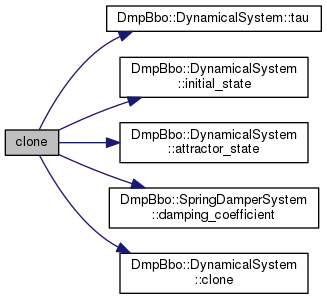
252  {
253  vector<FunctionApproximator*> function_approximators;
254  for (unsigned int ff=0; ff<function_approximators_.size(); ff++)
255  function_approximators.push_back(function_approximators_[ff]->clone());
256 
257  return new Dmp(tau(), initial_state(), attractor_state(), function_approximators,
258  spring_system_->damping_coefficient(), goal_system_->clone(),
259  phase_system_->clone(), gating_system_->clone());
260 }
double tau(void) const
Accessor function for the time constant.
Eigen::VectorXd initial_state(void) const
Accessor function for the initial state of the dynamical system.
double damping_coefficient(void)
Accessor function for damping coefficient.
virtual DynamicalSystem * clone(void) const =0
Return a pointer to a deep copy of the DynamicalSystem object.
Eigen::VectorXd attractor_state(void) const
Accessor function for the attractor state of the dynamical system.
Dmp(double tau, Eigen::VectorXd y_init, Eigen::VectorXd y_attr, std::vector< FunctionApproximator * > function_approximators, double alpha_spring_damper, DynamicalSystem *goal_system, DynamicalSystem *phase_system, DynamicalSystem *gating_system, ForcingTermScaling scaling=NO_SCALING)
Initialization constructor.
Definition: Dmp.cpp:85

Here is the call graph for this function:

void integrateStart ( Eigen::Ref< Eigen::VectorXd >  x,
Eigen::Ref< Eigen::VectorXd >  xd 
) const
virtual

Start integrating the system.

Parameters
[out]x- The first vector of state variables
[out]xd- The first vector of rates of change of the state variables
Remarks
x and xd should be of size dim() X 1. This forces you to pre-allocate memory, which speeds things up (and also makes Eigen's Ref functionality easier to deal with).

Reimplemented from DynamicalSystem.

Definition at line 263 of file Dmp.cpp.

264 {
265  assert(x.size()==dim());
266  assert(xd.size()==dim());
267 
268  x.fill(0);
269  xd.fill(0);
270 
271  // Start integrating goal system if it exists
272  if (goal_system_==NULL)
273  {
274  // No goal system, simply set goal state to attractor state
275  x.GOAL = attractor_state();
276  xd.GOAL.fill(0);
277  }
278  else
279  {
280  // Goal system exists. Start integrating it.
281  goal_system_->integrateStart(x.GOAL,xd.GOAL);
282  }
283 
284 
285  // Set the attractor state of the spring system
286  spring_system_->set_attractor_state(x.GOAL);
287 
288  // Start integrating all futher subsystems
289  spring_system_->integrateStart(x.SPRING, xd.SPRING);
290  phase_system_->integrateStart( x.PHASE, xd.PHASE);
291  gating_system_->integrateStart(x.GATING, xd.GATING);
292 
293  // Add rates of change
294  differentialEquation(x,xd);
295 
296 }
virtual void set_attractor_state(const Eigen::Ref< const Eigen::VectorXd > &attractor_state)
Mutator function for the attractor state of the dynamical system.
int dim(void) const
Get the dimensionality of the dynamical system, i.e.
void differentialEquation(const Eigen::Ref< const Eigen::VectorXd > &x, Eigen::Ref< Eigen::VectorXd > xd) const
The differential equation which defines the system.
Definition: Dmp.cpp:344
virtual void integrateStart(Eigen::Ref< Eigen::VectorXd > x, Eigen::Ref< Eigen::VectorXd > xd) const
Start integrating the system.
Eigen::VectorXd attractor_state(void) const
Accessor function for the attractor state of the dynamical system.

Here is the call graph for this function:

void differentialEquation ( const Eigen::Ref< const Eigen::VectorXd > &  x,
Eigen::Ref< Eigen::VectorXd >  xd 
) const
virtual

The differential equation which defines the system.

It relates state values to rates of change of those state values

Parameters
[in]xcurrent state (column vector of size dim() X 1)
[out]xdrate of change in state (column vector of size dim() X 1)
Remarks
x and xd should be of size dim() X 1. This forces you to pre-allocate memory, which speeds things up (and also makes Eigen's Ref functionality easier to deal with).

Implements DynamicalSystem.

Definition at line 344 of file Dmp.cpp.

347 {
348 
349  ENTERING_REAL_TIME_CRITICAL_CODE
350 
351  attractor_state(attractor_state_prealloc_);
352  if (goal_system_==NULL)
353  {
354  // If there is no dynamical system for the delayed goal, the goal is
355  // simply the attractor state
356  spring_system_->set_attractor_state(attractor_state_prealloc_);
357  // with zero change
358  xd.GOAL.fill(0);
359  }
360  else
361  {
362  // Integrate goal system and get current goal state
363  goal_system_->set_attractor_state(attractor_state_prealloc_);
364  goal_system_->differentialEquation(x.GOAL, xd.GOAL);
365  // The goal state is the attractor state of the spring-damper system
366  spring_system_->set_attractor_state(x.GOAL);
367 
368  }
369 
370 
371  // Integrate spring damper system
372  // Forcing term is added to spring_state later
373  spring_system_->differentialEquation(x.SPRING, xd.SPRING);
374 
375 
376  // Non-linear forcing term
377  phase_system_->differentialEquation(x.PHASE, xd.PHASE);
378  gating_system_->differentialEquation(x.GATING, xd.GATING);
379 
380 
381  //MatrixXd phase_state(1,1);
382  //phase_state = x.PHASE;
383  computeFunctionApproximatorOutput(x.PHASE, fa_output_prealloc_);
384 
385  // Gate the output of the function approximators
386  int t0 = 0;
387  double gating = (x.GATING)[0];
388  forcing_term_prealloc_ = gating*fa_output_prealloc_.row(t0);
389 
390 
391  // Scale the forcing term, if necessary
392  if (forcing_term_scaling_==G_MINUS_Y0_SCALING)
393  {
394  initial_state(initial_state_prealloc_);
395  g_minus_y0_prealloc_ = (attractor_state_prealloc_-initial_state_prealloc_).transpose();
396  forcing_term_prealloc_ = forcing_term_prealloc_.array()*g_minus_y0_prealloc_.array();
397  }
398  else if (forcing_term_scaling_==AMPLITUDE_SCALING)
399  {
400  forcing_term_prealloc_ = forcing_term_prealloc_.array()*trajectory_amplitudes_.array();
401  }
402 
403  // Add forcing term to the ZD component of the spring state
404  xd.SPRING_Z = xd.SPRING_Z + forcing_term_prealloc_/tau();
405 
406  EXITING_REAL_TIME_CRITICAL_CODE
407 
408 }
double tau(void) const
Accessor function for the time constant.
virtual void set_attractor_state(const Eigen::Ref< const Eigen::VectorXd > &attractor_state)
Mutator function for the attractor state of the dynamical system.
Eigen::VectorXd initial_state(void) const
Accessor function for the initial state of the dynamical system.
virtual void differentialEquation(const Eigen::Ref< const Eigen::VectorXd > &x, Eigen::Ref< Eigen::VectorXd > xd) const =0
The differential equation which defines the system.
virtual void computeFunctionApproximatorOutput(const Eigen::Ref< const Eigen::MatrixXd > &phase_state, Eigen::MatrixXd &fa_output) const
Compute the outputs of the function approximators.
Definition: Dmp.cpp:313
void differentialEquation(const Eigen::Ref< const Eigen::VectorXd > &x, Eigen::Ref< Eigen::VectorXd > xd) const
The differential equation which defines the system.
Eigen::VectorXd attractor_state(void) const
Accessor function for the attractor state of the dynamical system.

Here is the call graph for this function:

void analyticalSolution ( const Eigen::VectorXd &  ts,
Eigen::MatrixXd &  xs,
Eigen::MatrixXd &  xds,
Eigen::MatrixXd &  forcing_terms,
Eigen::MatrixXd &  fa_output 
) const

Return analytical solution of the system at certain times (and return forcing terms)

Parameters
[in]tsA vector of times for which to compute the analytical solutions
[out]xsSequence of state vectors. T x D or D x T matrix, where T is the number of times (the length of 'ts'), and D the size of the state (i.e. dim())
[out]xdsSequence of state vectors (rates of change). T x D or D x T matrix, where T is the number of times (the length of 'ts'), and D the size of the state (i.e. dim())
[out]forcing_termsThe forcing terms for each dimension, for debugging purposes only.
[out]fa_outputThe output of the function approximators, for debugging purposes only.
Remarks
The output xs and xds will be of size D x T only if the matrix x you pass as an argument of size D x T. In all other cases (i.e. including passing an empty matrix) the size of x will be T x D. This feature has been added so that you may pass matrices of either size.

Definition at line 449 of file Dmp.cpp.

450 {
451  int n_time_steps = ts.size();
452  assert(n_time_steps>0);
453 
454  // Usually, we expect xs and xds to be of size T X dim(), so we resize to that. However, if the
455  // input matrices were of size dim() X T, we return the matrices of that size by doing a
456  // transposeInPlace at the end. That way, the user can also request dim() X T sized matrices.
457  bool caller_expects_transposed = (xs.rows()==dim() && xs.cols()==n_time_steps);
458 
459  // INTEGRATE SYSTEMS ANALYTICALLY AS MUCH AS POSSIBLE
460 
461  // Integrate phase
462  MatrixXd xs_phase;
463  MatrixXd xds_phase;
464  phase_system_->analyticalSolution(ts,xs_phase,xds_phase);
465 
466  // Compute gating term
467  MatrixXd xs_gating;
468  MatrixXd xds_gating;
469  gating_system_->analyticalSolution(ts,xs_gating,xds_gating);
470 
471  // Compute the output of the function approximator
472  fa_outputs.resize(ts.size(),dim_orig());
473  fa_outputs.fill(0.0);
474  //if (isTrained())
475  computeFunctionApproximatorOutput(xs_phase, fa_outputs);
476 
477  // Gate the output to get the forcing term
478  MatrixXd xs_gating_rep = xs_gating.replicate(1,fa_outputs.cols());
479  forcing_terms = fa_outputs.array()*xs_gating_rep.array();
480 
481  // Scale the forcing term, if necessary
482  if (forcing_term_scaling_==G_MINUS_Y0_SCALING)
483  {
484  MatrixXd g_minus_y0_rep = (attractor_state()-initial_state()).transpose().replicate(n_time_steps,1);
485  forcing_terms = forcing_terms.array()*g_minus_y0_rep.array();
486  }
487  else if (forcing_term_scaling_==AMPLITUDE_SCALING)
488  {
489  MatrixXd trajectory_amplitudes_rep = trajectory_amplitudes_.transpose().replicate(n_time_steps,1);
490  forcing_terms = forcing_terms.array()*trajectory_amplitudes_rep.array();
491  }
492 
493 
494  MatrixXd xs_goal, xds_goal;
495  // Get current delayed goal
496  if (goal_system_==NULL)
497  {
498  // If there is no dynamical system for the delayed goal, the goal is
499  // simply the attractor state
500  xs_goal = attractor_state().transpose().replicate(n_time_steps,1);
501  // with zero change
502  xds_goal = MatrixXd::Zero(n_time_steps,dim_orig());
503  }
504  else
505  {
506  // Integrate goal system and get current goal state
507  goal_system_->analyticalSolution(ts,xs_goal,xds_goal);
508  }
509 
510  xs.resize(n_time_steps,dim());
511  xds.resize(n_time_steps,dim());
512 
513  int T = n_time_steps;
514 
515  xs.GOALM(T) = xs_goal; xds.GOALM(T) = xds_goal;
516  xs.PHASEM(T) = xs_phase; xds.PHASEM(T) = xds_phase;
517  xs.GATINGM(T) = xs_gating; xds.GATINGM(T) = xds_gating;
518 
519 
520  // THE REST CANNOT BE DONE ANALYTICALLY
521 
522  // Reset the dynamical system, and get the first state
523  double damping = spring_system_->damping_coefficient();
524  SpringDamperSystem localspring_system_(tau(),initial_state(),attractor_state(),damping);
525 
526  // Set first attractor state
527  localspring_system_.set_attractor_state(xs_goal.row(0));
528 
529  // Start integrating spring damper system
530  int dim_spring = localspring_system_.dim();
531  VectorXd x_spring(dim_spring), xd_spring(dim_spring); // todo Why are these needed?
532  int t0 = 0;
533  localspring_system_.integrateStart(x_spring, xd_spring);
534  xs.row(t0).SPRING = x_spring;
535  xds.row(t0).SPRING = xd_spring;
536 
537  // Add forcing term to the acceleration of the spring state
538  xds.SPRINGM_Z(1) = xds.SPRINGM_Z(1) + forcing_terms.row(t0)/tau();
539 
540  // Initialize perturber, if necessary
541  if (analytical_solution_perturber_==NULL && perturbation_standard_deviation_>0.0)
542  {
543  boost::normal_distribution<> normal(0, perturbation_standard_deviation_);
544  analytical_solution_perturber_ = new boost::variate_generator<boost::mt19937&, boost::normal_distribution<> >(rng, normal);
545  }
546 
547 
548  for (int tt=1; tt<n_time_steps; tt++)
549  {
550  double dt = ts[tt]-ts[tt-1];
551 
552  // Euler integration
553  xs.row(tt).SPRING = xs.row(tt-1).SPRING + dt*xds.row(tt-1).SPRING;
554 
555  // Set the attractor state of the spring system
556  localspring_system_.set_attractor_state(xs.row(tt).GOAL);
557 
558  // Integrate spring damper system
559  localspring_system_.differentialEquation(xs.row(tt).SPRING, xd_spring);
560  xds.row(tt).SPRING = xd_spring;
561 
562  // If necessary add a perturbation. May be useful for some off-line tests.
563  RowVectorXd perturbation = RowVectorXd::Constant(dim_orig(),0.0);
564  if (analytical_solution_perturber_!=NULL)
565  for (int i_dim=0; i_dim<dim_orig(); i_dim++)
566  // Sample perturbation from a normal Gaussian distribution
567  perturbation(i_dim) = (*analytical_solution_perturber_)();
568 
569  // Add forcing term to the acceleration of the spring state
570  xds.row(tt).SPRING_Z = xds.row(tt).SPRING_Z + forcing_terms.row(tt)/tau() + perturbation;
571  // Compute y component from z
572  xds.row(tt).SPRING_Y = xs.row(tt).SPRING_Z/tau();
573 
574  }
575 
576  if (caller_expects_transposed)
577  {
578  xs.transposeInPlace();
579  xds.transposeInPlace();
580  }
581 }
double tau(void) const
Accessor function for the time constant.
virtual void analyticalSolution(const Eigen::VectorXd &ts, Eigen::MatrixXd &xs, Eigen::MatrixXd &xds) const =0
Return analytical solution of the system at certain times.
int dim_orig(void) const
Get the dimensionality of the dynamical system, i.e.
Eigen::VectorXd initial_state(void) const
Accessor function for the initial state of the dynamical system.
int dim(void) const
Get the dimensionality of the dynamical system, i.e.
double damping_coefficient(void)
Accessor function for damping coefficient.
virtual void computeFunctionApproximatorOutput(const Eigen::Ref< const Eigen::MatrixXd > &phase_state, Eigen::MatrixXd &fa_output) const
Compute the outputs of the function approximators.
Definition: Dmp.cpp:313
Eigen::VectorXd attractor_state(void) const
Accessor function for the attractor state of the dynamical system.

Here is the call graph for this function:

void analyticalSolution ( const Eigen::VectorXd &  ts,
Eigen::MatrixXd &  xs,
Eigen::MatrixXd &  xds,
Eigen::MatrixXd &  forcing_terms 
) const
inline

Return analytical solution of the system at certain times (and return forcing terms)

Parameters
[in]tsA vector of times for which to compute the analytical solutions
[out]xsSequence of state vectors. T x D or D x T matrix, where T is the number of times (the length of 'ts'), and D the size of the state (i.e. dim())
[out]xdsSequence of state vectors (rates of change). T x D or D x T matrix, where T is the number of times (the length of 'ts'), and D the size of the state (i.e. dim())
[out]forcing_termsThe forcing terms for each dimension, for debugging purposes only.
Remarks
The output xs and xds will be of size D x T only if the matrix x you pass as an argument of size D x T. In all other cases (i.e. including passing an empty matrix) the size of x will be T x D. This feature has been added so that you may pass matrices of either size.

Definition at line 174 of file Dmp.hpp.

175  {
176  Eigen::MatrixXd fa_output;
177  analyticalSolution(ts, xs, xds, forcing_terms, fa_output);
178  }
void analyticalSolution(const Eigen::VectorXd &ts, Eigen::MatrixXd &xs, Eigen::MatrixXd &xds, Eigen::MatrixXd &forcing_terms, Eigen::MatrixXd &fa_output) const
Return analytical solution of the system at certain times (and return forcing terms) ...
Definition: Dmp.cpp:449

Here is the call graph for this function:

void analyticalSolution ( const Eigen::VectorXd &  ts,
Eigen::MatrixXd &  xs,
Eigen::MatrixXd &  xds 
) const
inlinevirtual

Return analytical solution of the system at certain times.

Parameters
[in]tsA vector of times for which to compute the analytical solutions
[out]xsSequence of state vectors. T x D or D x T matrix, where T is the number of times (the length of 'ts'), and D the size of the state (i.e. dim())
[out]xdsSequence of state vectors (rates of change). T x D or D x T matrix, where T is the number of times (the length of 'ts'), and D the size of the state (i.e. dim())
Remarks
The output xs and xds will be of size D x T only if the matrix x you pass as an argument of size D x T. In all other cases (i.e. including passing an empty matrix) the size of x will be T x D. This feature has been added so that you may pass matrices of either size.

Implements DynamicalSystem.

Definition at line 180 of file Dmp.hpp.

181  {
182  Eigen::MatrixXd forcing_terms, fa_output;
183  analyticalSolution(ts, xs, xds, forcing_terms, fa_output);
184  }
void analyticalSolution(const Eigen::VectorXd &ts, Eigen::MatrixXd &xs, Eigen::MatrixXd &xds, Eigen::MatrixXd &forcing_terms, Eigen::MatrixXd &fa_output) const
Return analytical solution of the system at certain times (and return forcing terms) ...
Definition: Dmp.cpp:449

Here is the call graph for this function:

virtual void analyticalSolution ( const Eigen::VectorXd &  ts,
Trajectory trajectory 
) const
inlinevirtual

Return analytical solution of the system at certain times.

Parameters
[in]tsA vector of times for which to compute the analytical solutions
[out]trajectoryThe computed states as a trajectory.

Reimplemented in DmpWithGainSchedules.

Definition at line 192 of file Dmp.hpp.

193  {
194  Eigen::MatrixXd xs, xds;
195  analyticalSolution(ts, xs, xds);
196  statesAsTrajectory(ts, xs, xds, trajectory);
197  }
virtual void statesAsTrajectory(const Eigen::MatrixXd &x_in, const Eigen::MatrixXd &xd_in, Eigen::MatrixXd &y_out, Eigen::MatrixXd &yd_out, Eigen::MatrixXd &ydd_out) const
Get the output of a DMP dynamical system as a trajectory.
Definition: Dmp.cpp:410
void analyticalSolution(const Eigen::VectorXd &ts, Eigen::MatrixXd &xs, Eigen::MatrixXd &xds, Eigen::MatrixXd &forcing_terms, Eigen::MatrixXd &fa_output) const
Return analytical solution of the system at certain times (and return forcing terms) ...
Definition: Dmp.cpp:449

Here is the call graph for this function:

void analyticalSolution ( const Eigen::VectorXd &  ts,
Trajectory trajectory,
Eigen::MatrixXd &  forcing_terms 
) const
inline

Return analytical solution of the system at certain times.

Parameters
[in]tsA vector of times for which to compute the analytical solutions
[out]trajectoryThe computed states as a trajectory.
[out]forcing_termsThe forcing terms

Definition at line 206 of file Dmp.hpp.
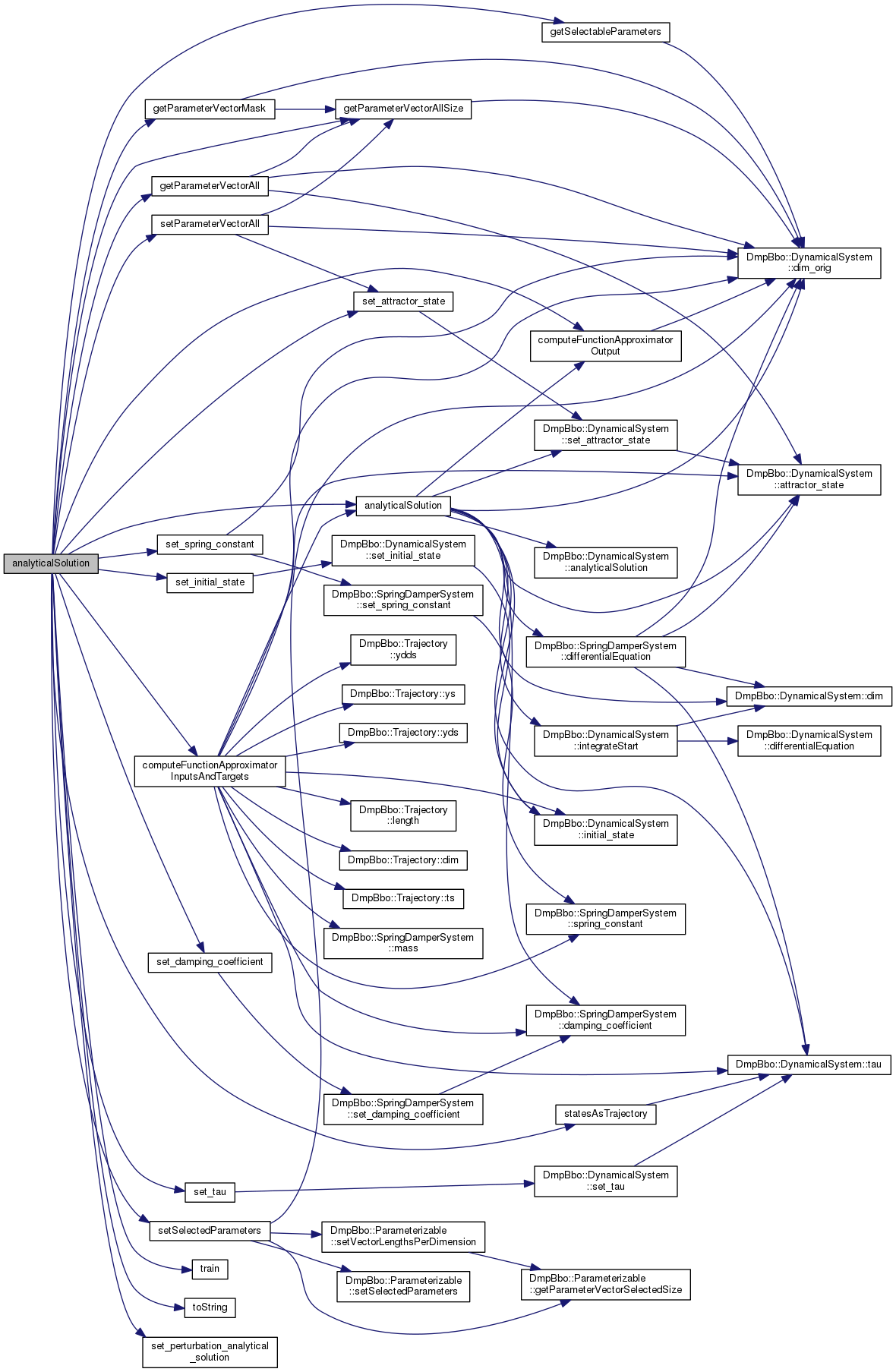
207  {
208  Eigen::MatrixXd xs, xds;
209  analyticalSolution(ts, xs, xds, forcing_terms);
210  statesAsTrajectory(ts, xs, xds, trajectory);
211  }
virtual void statesAsTrajectory(const Eigen::MatrixXd &x_in, const Eigen::MatrixXd &xd_in, Eigen::MatrixXd &y_out, Eigen::MatrixXd &yd_out, Eigen::MatrixXd &ydd_out) const
Get the output of a DMP dynamical system as a trajectory.
Definition: Dmp.cpp:410
void analyticalSolution(const Eigen::VectorXd &ts, Eigen::MatrixXd &xs, Eigen::MatrixXd &xds, Eigen::MatrixXd &forcing_terms, Eigen::MatrixXd &fa_output) const
Return analytical solution of the system at certain times (and return forcing terms) ...
Definition: Dmp.cpp:449

Here is the call graph for this function:

void statesAsTrajectory ( const Eigen::MatrixXd &  x_in,
const Eigen::MatrixXd &  xd_in,
Eigen::MatrixXd &  y_out,
Eigen::MatrixXd &  yd_out,
Eigen::MatrixXd &  ydd_out 
) const
virtual

Get the output of a DMP dynamical system as a trajectory.

As a dynamical system, the state vector of a DMP contains the output of the goal, spring, phase and gating system. What we are most interested in is the output of the spring system. This function extracts that information, and also computes the accelerations of the spring system, which are only stored implicitely in xd_in because second order systems are converted to first order systems with expanded state.

Parameters
[in]x_inState vector over time (size n_time_steps X dim())
[in]xd_inState vector over time (rates of change)
[out]y_outState vector over time (size n_time_steps X dim_orig())
[out]yd_outState vector over time (rates of change)
[out]ydd_outState vector over time (rates of change of rates of change)

Definition at line 410 of file Dmp.cpp.

411 {
412  int n_time_steps = x_in.rows();
413  y_out = x_in.SPRINGM_Y(n_time_steps);
414  yd_out = xd_in.SPRINGM_Y(n_time_steps);
415  ydd_out = xd_in.SPRINGM_Z(n_time_steps)/tau();
416  // MatrixXd z_out, zd_out;
417  // z_out = x_in.SPRINGM_Z(n_time_steps);
418  // zd_out = xd_in.SPRINGM_Z(n_time_steps);
419  // Divide by tau to go from z to y space
420  // yd = z_out/obj.tau;
421  // ydd_out = zd_out/tau();
422 }
double tau(void) const
Accessor function for the time constant.

Here is the call graph for this function:

void statesAsTrajectory ( const Eigen::VectorXd &  ts,
const Eigen::MatrixXd &  x_in,
const Eigen::MatrixXd &  xd_in,
Trajectory trajectory 
) const
virtual

Get the output of a DMP dynamical system as a trajectory.

As a dynamical system, the state vector of a DMP contains the output of the goal, spring, phase and gating system. What we are most interested in is the output of the spring system. This function extracts that information, and also computes the accelerations of the spring system, which are only stored implicitely in xd_in because second order systems are converted to first order systems with expanded state.

Parameters
[in]tsA vector of times
[in]x_inState vector over time
[in]xd_inState vector over time (rates of change)
[out]trajectoryTrajectory representation of the DMP state vector output.

Definition at line 425 of file Dmp.cpp.

425  {
426  int n_time_steps = ts.rows();
427 #ifndef NDEBUG // Variables below are only required for asserts; check for NDEBUG to avoid warnings.
428  int n_dims = x_in.cols();
429 #endif
430  assert(n_time_steps==x_in.rows());
431  assert(n_time_steps==xd_in.rows());
432  assert(n_dims==xd_in.cols());
433 
434  // Left column is time
435  Trajectory new_trajectory(
436  ts,
437  // y_out (see function above)
438  x_in.SPRINGM_Y(n_time_steps),
439  // yd_out (see function above)
440  xd_in.SPRINGM_Y(n_time_steps),
441  // ydd_out (see function above)
442  xd_in.SPRINGM_Z(n_time_steps)/tau()
443  );
444 
445  trajectory = new_trajectory;
446 
447 }
double tau(void) const
Accessor function for the time constant.

Here is the call graph for this function:

void train ( const Trajectory trajectory)
virtual

Train a DMP with a trajectory.

Parameters
[in]trajectoryThe trajectory with which to train the DMP.

Reimplemented in DmpWithGainSchedules.

Definition at line 643 of file Dmp.cpp.

644 {
645  train(trajectory,"");
646 }
virtual void train(const Trajectory &trajectory)
Train a DMP with a trajectory.
Definition: Dmp.cpp:643
void train ( const Trajectory trajectory,
std::string  save_directory,
bool  overwrite = false 
)
virtual

Train a DMP with a trajectory, and write results to file.

Parameters
[in]trajectoryThe trajectory with which to train the DMP.
[in]save_directoryThe directory to which to save the results.
[in]overwriteOverwrite existing files in the directory above (default: false)

Reimplemented in DmpWithGainSchedules.

Definition at line 648 of file Dmp.cpp.

649 {
650 
651  // Set tau, initial_state and attractor_state from the trajectory
652  set_tau(trajectory.duration());
653  set_initial_state(trajectory.initial_y());
654  set_attractor_state(trajectory.final_y());
655 
656  // This needs to be computed for (optional) scaling of the forcing term.
657  // Needs to be done BEFORE computeFunctionApproximatorInputsAndTargets
658  trajectory_amplitudes_ = trajectory.getRangePerDim();
659 
660  VectorXd fa_input_phase;
661  MatrixXd f_target;
662  computeFunctionApproximatorInputsAndTargets(trajectory, fa_input_phase, f_target);
663 
664  // Some checks before training function approximators
665  assert(!function_approximators_.empty());
666 
667  for (unsigned int dd=0; dd<function_approximators_.size(); dd++)
668  {
669  // This is just boring stuff to figure out if and where to store the results of training
670  string save_directory_dim;
671  if (!save_directory.empty())
672  {
673  if (function_approximators_.size()==1)
674  save_directory_dim = save_directory;
675  else
676  save_directory_dim = save_directory + "/dim" + to_string(dd);
677  }
678 
679  // Actual training is happening here.
680  VectorXd fa_target = f_target.col(dd);
681  if (function_approximators_[dd]==NULL)
682  {
683  cerr << __FILE__ << ":" << __LINE__ << ":";
684  cerr << "WARNING: function approximator cannot be trained because it is NULL." << endl;
685  }
686  else
687  {
688  if (function_approximators_[dd]->isTrained())
689  function_approximators_[dd]->reTrain(fa_input_phase,fa_target,save_directory_dim,overwrite);
690  else
691  function_approximators_[dd]->train(fa_input_phase,fa_target,save_directory_dim,overwrite);
692  }
693  }
694 
695  if (!save_directory.empty())
696  {
697  int n_time_steps = 101;
698  VectorXd ts = VectorXd::LinSpaced(n_time_steps,0,tau());
699  Trajectory traj_reproduced;
700  analyticalSolution(ts,traj_reproduced);
701 
702  trajectory.saveToFile(save_directory,"traj_demonstration.txt",overwrite);
703  traj_reproduced.saveToFile(save_directory,"traj_reproduced.txt",overwrite);
704  }
705 
706 }
double tau(void) const
Accessor function for the time constant.
virtual void set_attractor_state(const Eigen::VectorXd &y_attr)
Accessor function for the attractor state of the system.
Definition: Dmp.cpp:873
virtual void set_tau(double tau)
Accessor function for the time constant.
Definition: Dmp.cpp:853
void computeFunctionApproximatorInputsAndTargets(const Trajectory &trajectory, Eigen::VectorXd &fa_inputs_phase, Eigen::MatrixXd &fa_targets) const
Given a trajectory, compute the inputs and targets for the function approximators.
Definition: Dmp.cpp:583
virtual void set_initial_state(const Eigen::VectorXd &y_init)
Accessor function for the initial state of the system.
Definition: Dmp.cpp:864
void analyticalSolution(const Eigen::VectorXd &ts, Eigen::MatrixXd &xs, Eigen::MatrixXd &xds, Eigen::MatrixXd &forcing_terms, Eigen::MatrixXd &fa_output) const
Return analytical solution of the system at certain times (and return forcing terms) ...
Definition: Dmp.cpp:449

Here is the call graph for this function:

void set_tau ( double  tau)
virtual

Accessor function for the time constant.

Parameters
[in]tauTime constant We need to override DynamicalSystem::set_tau, because the DMP must also change the time constant of all of its subsystems.

Reimplemented from DynamicalSystem.

Definition at line 853 of file Dmp.cpp.

853  {
855 
856  // Set value in all relevant subsystems also
857  spring_system_->set_tau(tau);
858  if (goal_system_!=NULL)
859  goal_system_->set_tau(tau);
860  phase_system_ ->set_tau(tau);
861  gating_system_->set_tau(tau);
862 }
double tau(void) const
Accessor function for the time constant.
virtual void set_tau(double tau)
Mutator function for the time constant.

Here is the call graph for this function:

void set_initial_state ( const Eigen::VectorXd &  y_init)
virtual

Accessor function for the initial state of the system.

Parameters
[in]y_initInitial state of the system. We need to override DynamicalSystem::set_initial_state, because the DMP must also change the initial state of the goal system as well.

Reimplemented from DynamicalSystem.

Definition at line 864 of file Dmp.cpp.

864  {
866 
867  // Set value in all relevant subsystems also
868  spring_system_->set_initial_state(y_init);
869  if (goal_system_!=NULL)
870  goal_system_->set_initial_state(y_init);
871 }
virtual void set_initial_state(const Eigen::VectorXd &initial_state)
Mutator function for the initial state of the dynamical system.

Here is the call graph for this function:

void set_attractor_state ( const Eigen::VectorXd &  y_attr)
virtual

Accessor function for the attractor state of the system.

Parameters
[in]y_attrAttractor state of the system.

Definition at line 873 of file Dmp.cpp.

873  {
875 
876  // Set value in all relevant subsystems also
877  if (goal_system_!=NULL)
878  goal_system_->set_attractor_state(y_attr);
879 
880  // Do NOT do the following. The attractor state of the spring system is determined by the goal
881  // system
882  // spring_system_->set_attractor_state(y_attr);
883 
884 }
virtual void set_attractor_state(const Eigen::Ref< const Eigen::VectorXd > &attractor_state)
Mutator function for the attractor state of the dynamical system.

Here is the call graph for this function:

void set_damping_coefficient ( double  damping_coefficient)

Accessor function for damping coefficient of spring-damper system.

Parameters
[in]damping_coefficientDamping coefficient

Definition at line 215 of file Dmp.cpp.

216 {
217  spring_system_->set_damping_coefficient(damping_coefficient);
218 }
void set_damping_coefficient(double damping_coefficient)
Accessor function for damping coefficient.

Here is the call graph for this function:

void set_spring_constant ( double  spring_constant)

Accessor function for spring constant of spring-damper system.

Parameters
[in]spring_constantSpring constant

Definition at line 219 of file Dmp.cpp.

219  {
220  spring_system_->set_spring_constant(spring_constant);
221 }
void set_spring_constant(double spring_constant)
Accessor function for spring constant.

Here is the call graph for this function:

string toString ( void  ) const
virtual

Returns a string representation of the object.

Returns
A string representation of the object.

Implements DynamicalSystem.

Definition at line 893 of file Dmp.cpp.

894 {
896 }
#define RETURN_STRING_FROM_BOOST_SERIALIZATION_XML(name)
Macro to convert the boost XML serialization of an object into a string.
void getSelectableParameters ( std::set< std::string > &  selected_values_labels) const
virtual

Return all the names of the parameter types that can be selected.

Parameters
[out]selected_values_labelsNames of the parameter types that can be selected

Implements Parameterizable.

Definition at line 708 of file Dmp.cpp.

708  {
709  assert(function_approximators_.size()>0);
710  for (int dd=0; dd<dim_orig(); dd++)
711  {
712  if (function_approximators_[dd]!=NULL)
713  {
714  if (function_approximators_[dd]->isTrained())
715  {
716  set<string> cur_labels;
717  function_approximators_[dd]->getSelectableParameters(cur_labels);
718  selectable_values_labels.insert(cur_labels.begin(), cur_labels.end());
719  }
720  }
721  }
722  selectable_values_labels.insert("goal");
723 
724  //cout << "selected_values_labels=[";
725  //for (string label : selected_values_labels)
726  // cout << label << " ";
727  //cout << "]" << endl;
728 
729 }
int dim_orig(void) const
Get the dimensionality of the dynamical system, i.e.

Here is the call graph for this function:

void setSelectedParameters ( const std::set< std::string > &  selected_values_labels)
virtual

Determine which subset of parameters is represented in the vector returned by Parameterizable::getParameterVectorSelected.

Different function approximators have different types of model parameters. For instance, LWR has the centers and widths of basis functions, along with the slopes of each line segment. Parameterizable::setSelectedParameters provides a means to determine which parameters should be returned by Parameterizable::getParameterVectorSelected, i.e. by calling: std::set<std::string> selected; selected.insert("slopes"); model_parameters.setSelectedParameters(selected)

Parameters
[in]selected_values_labelsThe names of the parameters that are selected

Reimplemented from Parameterizable.

Definition at line 731 of file Dmp.cpp.
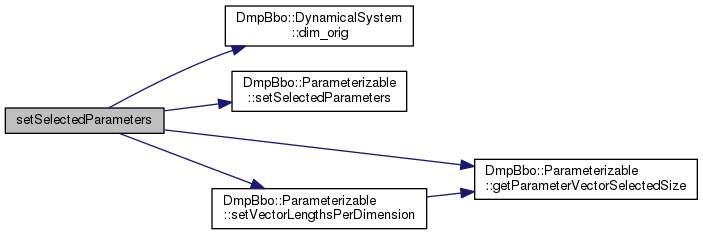
732 {
733  assert(function_approximators_.size()>0);
734  for (int dd=0; dd<dim_orig(); dd++)
735  if (function_approximators_[dd]!=NULL)
736  if (function_approximators_[dd]->isTrained())
737  function_approximators_[dd]->setSelectedParameters(selected_values_labels);
738 
739  // Call superclass for initializations
740  Parameterizable::setSelectedParameters(selected_values_labels);
741 
742  VectorXi lengths_per_dimension = VectorXi::Zero(dim_orig());
743  for (int dd=0; dd<dim_orig(); dd++)
744  {
745  if (function_approximators_[dd]!=NULL)
746  if (function_approximators_[dd]->isTrained())
747  lengths_per_dimension[dd] = function_approximators_[dd]->getParameterVectorSelectedSize();
748 
749  if (selected_values_labels.find("goal")!=selected_values_labels.end())
750  lengths_per_dimension[dd]++;
751  }
752 
753  setVectorLengthsPerDimension(lengths_per_dimension);
754 
755 }
void setVectorLengthsPerDimension(const Eigen::VectorXi &lengths_per_dimension)
The vector (VectorXd) with parameter values can be split into different parts (as vector<VectorXd>; t...
int dim_orig(void) const
Get the dimensionality of the dynamical system, i.e.
void setSelectedParameters(const std::set< std::string > &selected_values_labels)
Determine which subset of parameters is represented in the vector returned by Parameterizable::getPar...
Definition: Dmp.cpp:731
virtual void setSelectedParameters(const std::set< std::string > &selected_values_labels)
Determine which subset of parameters is represented in the vector returned by Parameterizable::getPar...
virtual int getParameterVectorSelectedSize(void) const
Get the size of the vector of selected parameters, as returned by getParameterVectorSelected(.

Here is the call graph for this function:

int getParameterVectorAllSize ( void  ) const
virtual

Get the size of the parameter values vector when it contains all available parameter values.

Returns
The size of the parameter vector

For instance, if the parameters consists of centers, widths and slopes the parameter values vector will be something like

    centers     widths    slopes
[ 100 110 120 10 10 10 0.4 0.7 0.4 ]

then getParameterVectorAllSize() will return 9

Implements Parameterizable.

Definition at line 801 of file Dmp.cpp.

802 {
803  int total_size = 0;
804  for (unsigned int dd=0; dd<function_approximators_.size(); dd++)
805  total_size += function_approximators_[dd]->getParameterVectorAllSize();
806 
807  // For the goal
808  total_size += dim_orig();
809  return total_size;
810 }
int dim_orig(void) const
Get the dimensionality of the dynamical system, i.e.
int getParameterVectorAllSize(void) const
Get the size of the parameter values vector when it contains all available parameter values...
Definition: Dmp.cpp:801

Here is the call graph for this function:

void getParameterVectorAll ( Eigen::VectorXd &  values) const
virtual

Return a vector that returns all available parameter values.

Parameters
[out]valuesAll available parameter values in one vector.
Remarks
Contrast this with Parameterizable::getParameterVectorSelected, which return only the SELECTED parameter values. Selecting parameters is done with Parameterizable::setSelectedParameters

Implements Parameterizable.

Definition at line 813 of file Dmp.cpp.

814 {
815  values.resize(getParameterVectorAllSize());
816  int offset = 0;
817  VectorXd cur_values;
818  VectorXd attractor = attractor_state();
819  for (int dd=0; dd<dim_orig(); dd++)
820  {
821  function_approximators_[dd]->getParameterVectorAll(cur_values);
822  values.segment(offset,cur_values.size()) = cur_values;
823  offset += cur_values.size();
824 
825  values(offset) = attractor(dd);
826  offset++;
827  }
828 }
int dim_orig(void) const
Get the dimensionality of the dynamical system, i.e.
int getParameterVectorAllSize(void) const
Get the size of the parameter values vector when it contains all available parameter values...
Definition: Dmp.cpp:801
Eigen::VectorXd attractor_state(void) const
Accessor function for the attractor state of the dynamical system.

Here is the call graph for this function:

void setParameterVectorAll ( const Eigen::VectorXd &  values)
virtual

Set all available parameter values with one vector.

Parameters
[in]valuesAll available parameter values in one vector.
Remarks
Contrast this with Parameterizable::setParameterVectorSelected, which sets only the SELECTED parameter values. Selecting parameters is done with Parameterizable::setSelectedParameters

Implements Parameterizable.

Definition at line 830 of file Dmp.cpp.

831 {
832  assert(values.size()==getParameterVectorAllSize());
833  int offset = 0;
834  VectorXd cur_values;
835  VectorXd attractor(dim_orig());
836  for (int dd=0; dd<dim_orig(); dd++)
837  {
838  int n_parameters_required = function_approximators_[dd]->getParameterVectorAllSize();
839  cur_values = values.segment(offset,n_parameters_required);
840  function_approximators_[dd]->setParameterVectorAll(cur_values);
841  offset += n_parameters_required;
842 
843  attractor(dd) = values(offset);
844  offset += 1;
845  }
846 
847  // Set the goal
848  set_attractor_state(attractor);
849 }
virtual void set_attractor_state(const Eigen::VectorXd &y_attr)
Accessor function for the attractor state of the system.
Definition: Dmp.cpp:873
int dim_orig(void) const
Get the dimensionality of the dynamical system, i.e.
int getParameterVectorAllSize(void) const
Get the size of the parameter values vector when it contains all available parameter values...
Definition: Dmp.cpp:801

Here is the call graph for this function:

void getParameterVectorMask ( const std::set< std::string >  selected_values_labels,
Eigen::VectorXi &  selected_mask 
) const
virtual

Get a mask for selecting parameters.

Parameters
[in]selected_values_labelsLabels of the selected parameter values
[out]selected_maskA mask indicating indices of selected parameters. 0 indicates not selected, >0 indicates selected.

For instance, if the parameters consists of centers, widths and slopes the parameter values vector will be something like

    centers     widths    slopes
[ 100 110 120 10 10 10 0.4 0.7 0.4 ]

In this case, if selected_values_labels contains "centers" and "slopes", the mask will be:

    centers     widths    slopes
[   1   1   1  0  0  0   3   3   3 ]

The '0' indicates that these parameters are not selected. The other ones have different numbers so that they may be discerned from one another (as required in Parameterizable::getParameterVectorSelectedMinMax for instance.

Implements Parameterizable.

Definition at line 757 of file Dmp.cpp.

758 {
759  assert(function_approximators_.size()>0);
760  for (int dd=0; dd<dim_orig(); dd++)
761  {
762  assert(function_approximators_[dd]!=NULL);
763  assert(function_approximators_[dd]->isTrained());
764  }
765 
766  selected_mask.resize(getParameterVectorAllSize());
767  selected_mask.fill(0);
768 
769  const int TMP_GOAL_NUMBER = -1;
770  int offset = 0;
771  VectorXi cur_mask;
772  for (int dd=0; dd<dim_orig(); dd++)
773  {
774  function_approximators_[dd]->getParameterVectorMask(selected_values_labels,cur_mask);
775 
776  // This makes sure that the indices for each function approximator are different
777  int mask_offset = selected_mask.maxCoeff();
778  for (int ii=0; ii<cur_mask.size(); ii++)
779  if (cur_mask[ii]!=0)
780  cur_mask[ii] += mask_offset;
781 
782  selected_mask.segment(offset,cur_mask.size()) = cur_mask;
783  offset += cur_mask.size();
784 
785  // Goal
786  if (selected_values_labels.find("goal")!=selected_values_labels.end())
787  selected_mask(offset) = TMP_GOAL_NUMBER;
788  offset++;
789 
790  }
791  assert(offset == getParameterVectorAllSize());
792 
793  // Replace TMP_GOAL_NUMBER with current max value
794  int goal_number = selected_mask.maxCoeff() + 1;
795  for (int ii=0; ii<selected_mask.size(); ii++)
796  if (selected_mask[ii]==TMP_GOAL_NUMBER)
797  selected_mask[ii] = goal_number;
798 
799 }
int dim_orig(void) const
Get the dimensionality of the dynamical system, i.e.
int getParameterVectorAllSize(void) const
Get the size of the parameter values vector when it contains all available parameter values...
Definition: Dmp.cpp:801

Here is the call graph for this function:

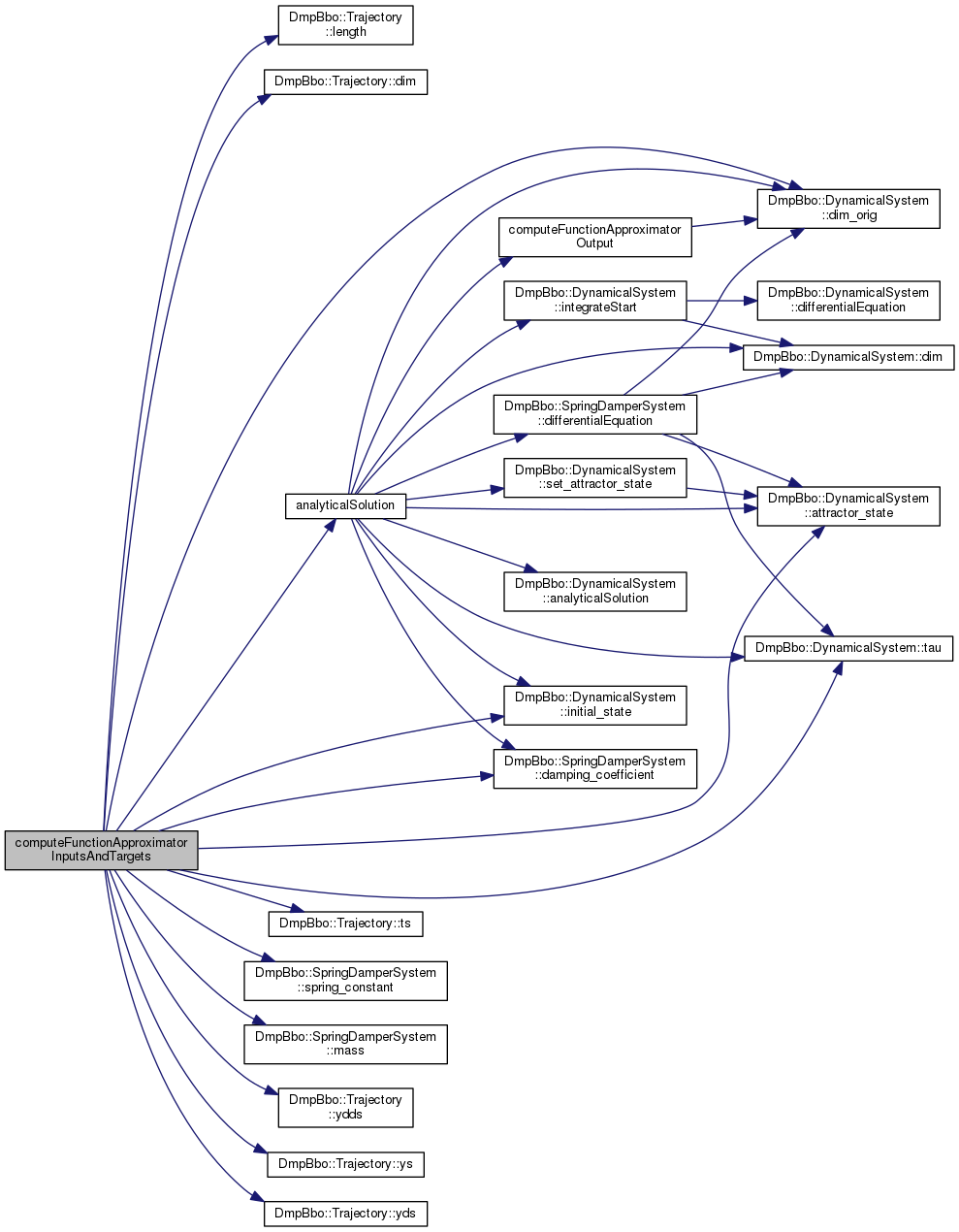
void computeFunctionApproximatorInputsAndTargets ( const Trajectory trajectory,
Eigen::VectorXd &  fa_inputs_phase,
Eigen::MatrixXd &  fa_targets 
) const

Given a trajectory, compute the inputs and targets for the function approximators.

For a standard Dmp (such as the one in this class) the inputs will be the phase over time, and the targets will be the forcing term (with the gating function factored out).

Parameters
[in]trajectoryTrajectory, e.g. a demonstration.
[out]fa_inputs_phaseThe inputs for the function approximators (phase signal)
[out]fa_targetsThe targets for the function approximators (forcing term)

Definition at line 583 of file Dmp.cpp.
584 {
585  int n_time_steps = trajectory.length();
586  double dim_data = trajectory.dim();
587 
588  if (dim_orig()!=dim_data)
589  {
590  cout << "WARNING: Cannot train " << dim_orig() << "-D DMP with " << dim_data << "-D data. Doing nothing." << endl;
591  return;
592  }
593 
594  // Integrate analytically to get goal, gating and phase states
595  MatrixXd xs_ana;
596  MatrixXd xds_ana;
597 
598  // Before, we would make clone of the dmp, and integrate it with the tau, and initial/attractor
599  // state of the trajectory. However, Thibaut needed to call this from outside the Dmp as well,
600  // with the tau/states of the this object. Therefore, we no longer clone.
601  // Dmp* dmp_clone = static_cast<Dmp*>(this->clone());
602  // dmp_clone->set_tau(trajectory.duration());
603  // dmp_clone->set_initial_state(trajectory.initial_y());
604  // dmp_clone->set_attractor_state(trajectory.final_y());
605  // dmp_clone->analyticalSolution(trajectory.ts(),xs_ana,xds_ana);
606  analyticalSolution(trajectory.ts(),xs_ana,xds_ana);
607  MatrixXd xs_goal = xs_ana.GOALM(n_time_steps);
608  MatrixXd xs_gating = xs_ana.GATINGM(n_time_steps);
609  MatrixXd xs_phase = xs_ana.PHASEM(n_time_steps);
610 
611  fa_inputs_phase = xs_phase;
612 
613  // Get parameters from the spring-dampers system to compute inverse
614  double damping_coefficient = spring_system_->damping_coefficient();
615  double spring_constant = spring_system_->spring_constant();
616  double mass = spring_system_->mass();
617  if (mass!=1.0)
618  {
619  cout << "WARNING: Usually, spring-damper system of the DMP should have mass==1, but it is " << mass << endl;
620  }
621 
622  // Compute inverse
623  f_target = tau()*tau()*trajectory.ydds() + (spring_constant*(trajectory.ys()-xs_goal) + damping_coefficient*tau()*trajectory.yds())/mass;
624 
625  //Factor out gating term
626  for (unsigned int dd=0; dd<function_approximators_.size(); dd++)
627  f_target.col(dd) = f_target.col(dd).array()/xs_gating.array();
628 
629  // Factor out scaling
630  if (forcing_term_scaling_==G_MINUS_Y0_SCALING)
631  {
632  MatrixXd g_minus_y0_rep = (attractor_state()-initial_state()).transpose().replicate(n_time_steps,1);
633  f_target = f_target.array()/g_minus_y0_rep.array();
634  }
635  else if (forcing_term_scaling_==AMPLITUDE_SCALING)
636  {
637  MatrixXd trajectory_amplitudes_rep = trajectory_amplitudes_.transpose().replicate(n_time_steps,1);
638  f_target = f_target.array()/trajectory_amplitudes_rep.array();
639  }
640 
641 }
double tau(void) const
Accessor function for the time constant.
int dim_orig(void) const
Get the dimensionality of the dynamical system, i.e.
Eigen::VectorXd initial_state(void) const
Accessor function for the initial state of the dynamical system.
double damping_coefficient(void)
Accessor function for damping coefficient.
Eigen::VectorXd attractor_state(void) const
Accessor function for the attractor state of the dynamical system.
double mass(void)
Accessor function for mass.
void analyticalSolution(const Eigen::VectorXd &ts, Eigen::MatrixXd &xs, Eigen::MatrixXd &xds, Eigen::MatrixXd &forcing_terms, Eigen::MatrixXd &fa_output) const
Return analytical solution of the system at certain times (and return forcing terms) ...
Definition: Dmp.cpp:449
double spring_constant(void)
Accessor function for spring constant.

Here is the call graph for this function:

void computeFunctionApproximatorOutput ( const Eigen::Ref< const Eigen::MatrixXd > &  phase_state,
Eigen::MatrixXd &  fa_output 
) const
virtual

Compute the outputs of the function approximators.

Parameters
[in]phase_stateThe phase states for which the outputs are computed.
[out]fa_outputThe outputs of the function approximators.

Reimplemented in DmpContextual, DmpContextualTwoStep, and DmpContextualOneStep.

Definition at line 313 of file Dmp.cpp.

314 {
315  int T = phase_state.rows();
316  fa_output.resize(T,dim_orig());
317  fa_output.fill(0.0);
318 
319  if (T>1) {
320  fa_outputs_prealloc_.resize(T,dim_orig());
321  }
322 
323  for (int i_dim=0; i_dim<dim_orig(); i_dim++)
324  {
325  if (function_approximators_[i_dim]!=NULL)
326  {
327  if (function_approximators_[i_dim]->isTrained())
328  {
329  if (T==1)
330  {
331  function_approximators_[i_dim]->predict(phase_state,fa_outputs_one_prealloc_);
332  fa_output.col(i_dim) = fa_outputs_one_prealloc_;
333  }
334  else
335  {
336  function_approximators_[i_dim]->predict(phase_state,fa_outputs_prealloc_);
337  fa_output.col(i_dim) = fa_outputs_prealloc_;
338  }
339  }
340  }
341  }
342 }
int dim_orig(void) const
Get the dimensionality of the dynamical system, i.e.

Here is the call graph for this function:

void set_perturbation_analytical_solution ( double  perturbation_standard_deviation)

Add a perturbation to the forcing term when computing the analytical solution.

This is only relevant for off-line experiments, i.e. not on a robot, for testing how the system responds to perturbations. Does not affect the output of Dmp::differentialEquation(), only of Dmp::analyticalSolution().

Parameters
[in]perturbation_standard_deviationStandard deviation of the normal distribution from which perturbations will be sampled.

Definition at line 886 of file Dmp.cpp.

887 {
888  perturbation_standard_deviation_ = perturbation_standard_deviation;
889  analytical_solution_perturber_ = NULL;
890 }
double get_perturbation_analytical_solution ( ) const
inline

Get the perturbation to the forcing term when computing the analytical solution.

Returns
Standard deviation of the normal distribution from which perturbations will be sampled.

Definition at line 334 of file Dmp.hpp.

335  {
336  return perturbation_standard_deviation_;
337  }
FunctionApproximator* function_approximator ( int  i_dim) const
inlineprotected

Get a pointer to the function approximator for a certain dimension.

Parameters
[in]i_dimDimension for which to get the function approximator
Returns
Pointer to the function approximator.

Definition at line 345 of file Dmp.hpp.

346  {
347  assert(i_dim<(int)function_approximators_.size());
348  return function_approximators_[i_dim];
349  }

Friends And Related Function Documentation

friend class boost::serialization::access
friend

Give boost serialization access to private members.

Definition at line 425 of file Dmp.hpp.


The documentation for this class was generated from the following files: